Updated 28 September 2026. The situation is developing quickly, and we will update this article as Congress and the courts respond.
On 25 September 2026, President Luiz Inácio Lula da Silva signed a Provisional Measure that ends the operation, offering, intermediation and advertising of fixed-odds betting in Brazil. Less than two years after the country launched one of the world’s largest regulated betting markets, licensed operators have days to leave it.
For iGaming brands, affiliates and creators, the headline is not only the ban itself. It is that advertising and recruiting players are now at the centre of enforcement, and a separate bill proposes prison sentences for anyone who promotes betting. Here is what has changed, why it matters for influencer marketing, and what to do next.
What exactly Brazil has banned
According to the official government announcement, the measure covers both sports betting and online casino games, in physical and online environments, including licences issued by states. Other lotteries already authorised by law are not affected.
- 25 September: the measure takes effect and new deposits are blocked.
- 5 October, 23:59: deadline for players to withdraw their balances and for operators to remove physical and outdoor advertising and sponsorship materials.
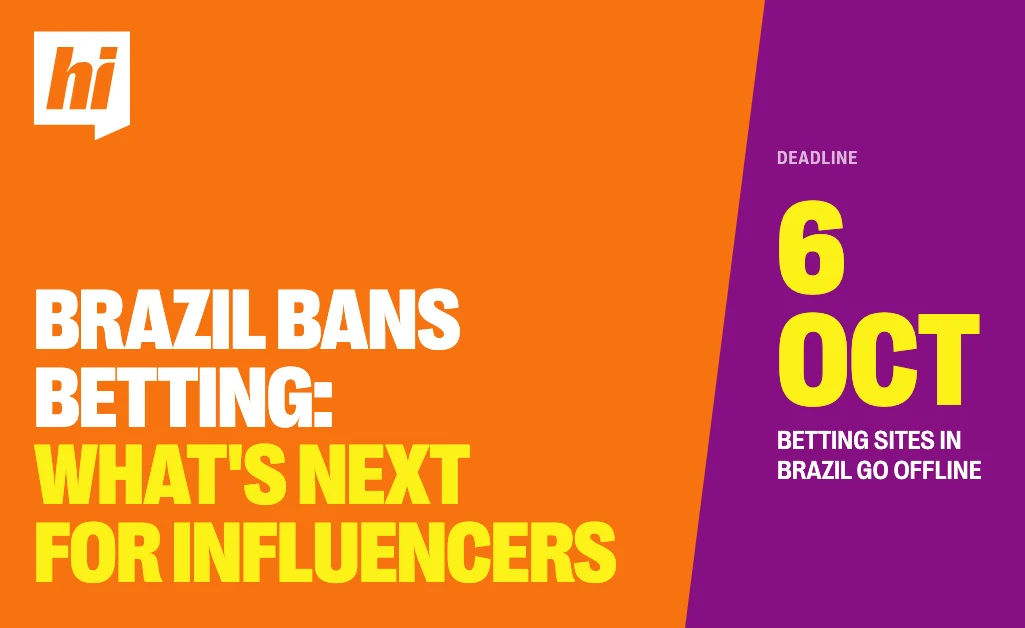
- 6 October: betting sites and apps go offline.
- 7–14 October: operators report remaining balances to banks, which return the money to players. From 14 October, the state bank Caixa handles any refunds that banks cannot complete.
The 85 licences issued so far, each costing R$30 million (R$2.55 billion in total), are cancelled “in the public interest”, with no compensation. Companies and individuals who break the rules face penalties ranging from warnings to fines of up to R$2 billion.
The government justifies the ban as a public health measure. It cites data showing that 10.9 million Brazilians showed risky or problematic gambling behaviour in 2023, and that gambling-related treatment in the public health system grew by around 140% between 2018 and 2025.
Why influencer marketing is in the firing line
Alongside the measure, the government has drafted a bill that creates five new criminal offences. Three of them matter most for marketers:
- Promoting betting or recruiting players: 2 to 4 years in prison plus a fine.
- Using personal data to recruit players: 2 to 4 years plus a fine, with harsher penalties when the data includes betting history or health information, or belongs to children and teenagers.
- Operating a betting business, even with a foreign licence: 4 to 6 years.
The bill still needs to pass Congress, but its direction is clear. Promotion of betting is being treated as part of the harm, not a side issue, and a licence from Curaçao or Malta is explicitly not a defence. For creators, affiliates and agencies, “switching to an offshore brand” is not a workaround. It is the scenario the bill was written to catch.
The reaction from Brazilian creators was immediate. Within a day of the announcement, well-known influencers linked to the betting market were posting videos criticising the ban and warning that players would move to illegal sites.
Brazil is not an isolated case
Brazil is the most dramatic example, but the same pressure on gambling promotion by creators is building elsewhere:
- X updated its Paid Partnerships policy in February 2026 to prohibit gambling promotions through paid creator deals, affiliate links, referral codes and ambassador programmes. Licensed operators can still buy formal ads where gambling is legal, but creator-led promotion on the platform is closed.
- In the UK, the Advertising Standards Authority applies the same rules to affiliate and influencer posts as it does to an operator’s own ads, and uses its AI-based Active Ad Monitoring system to proactively find problem ads, including gambling promotions that could appeal to under-18s.
- Streaming platforms keep revising their gambling content rules, which makes long-term deals built around a single platform riskier than they were two years ago. We explored this shift in how streaming is reshaping iGaming.
The common thread is that regulators and platforms no longer see creator marketing as a grey zone. It is being regulated as advertising, and in some markets, as something closer to the product itself.
What brands, affiliates and creators should do now
If you have Brazil-facing activity
- Stop all promotion targeting Brazil immediately. Pause live integrations, pinned links, promo codes and bio links that point Brazilian audiences to betting products, including on creator channels you do not control directly.
- Remove physical and outdoor materials before 5 October. This includes sponsorship assets such as stadium and kit branding.
- Review your creator contracts. Check termination, change-of-law and payment clauses so that both sides understand what happens to prepaid fees and revenue-share deals. If your agreements do not cover regulatory change, now is the time to fix that. See our guide to contracts and agreements with influencers.
- Audit how you use player and audience data. Under the proposed bill, using personal data to recruit players would be a crime in its own right. Stop any Brazil-related retargeting, lookalike audiences and CRM reactivation.
- Communicate clearly with creators. Many will be exposed personally. A short, written briefing on what to stop, what to remove and whom to contact protects them and your brand.
For every iGaming marketing team
- Stress-test your market concentration. If one country delivers most of your influencer-driven registrations, you have a regulatory risk as well as a commercial one. Brazil’s regulated market lasted just 21 months.
- Build compliance into every brief. Age verification, geo-targeting, clear ad labelling and safer gambling messaging should be part of the creative, not a disclaimer added at the end.
- Choose partners for trust, not just reach. Creators with real, adult, well-understood audiences are easier to defend to regulators and platforms. Verifying audiences also protects your budget, as we explained in how to detect fraud by influencers.
- Invest in owned channels and brand. Communities, content and brand search that you own are much harder to switch off than a promo code on someone else’s channel.
What to watch next
- Congress. A Provisional Measure takes effect immediately, but Congress must approve it within 120 days or it lapses. Debate is not expected to start until after the elections, which begin with the first round on 4 October.
- The courts. Industry associations, including ANJL and IBJR, are preparing a joint request to the Supreme Federal Court (STF) to suspend the measure. They argue that it lacks the urgency the constitution requires for a Provisional Measure and that it cannot override licences issued by states. Lawyers also say that licence holders may be entitled to compensation.
- The criminal bill. If it passes as drafted, promoting betting in Brazil becomes a crime punishable by prison, which would change the risk for every creator and agency working with the market.
- The illegal market. The main argument against the ban is that players will move to unlicensed sites. How quickly the authorities can block domains, apps and payment channels will decide whether the ban reduces harm or simply pushes it offshore.
The bottom line
Brazil has shown how quickly a regulated market can close, and how central influencer marketing has become to that debate. The brands that come through this well will be the ones that treat compliance, audience quality and diversification as part of their strategy, not as an afterthought.
At HiPublic, we help iGaming and gaming brands build influencer campaigns that perform and stay on the right side of the rules in every market they target. If you need to review your Brazil exposure or rebalance your creator strategy, get in touch.
This article is for general information and is not legal advice. Please consult a qualified lawyer about your specific situation.